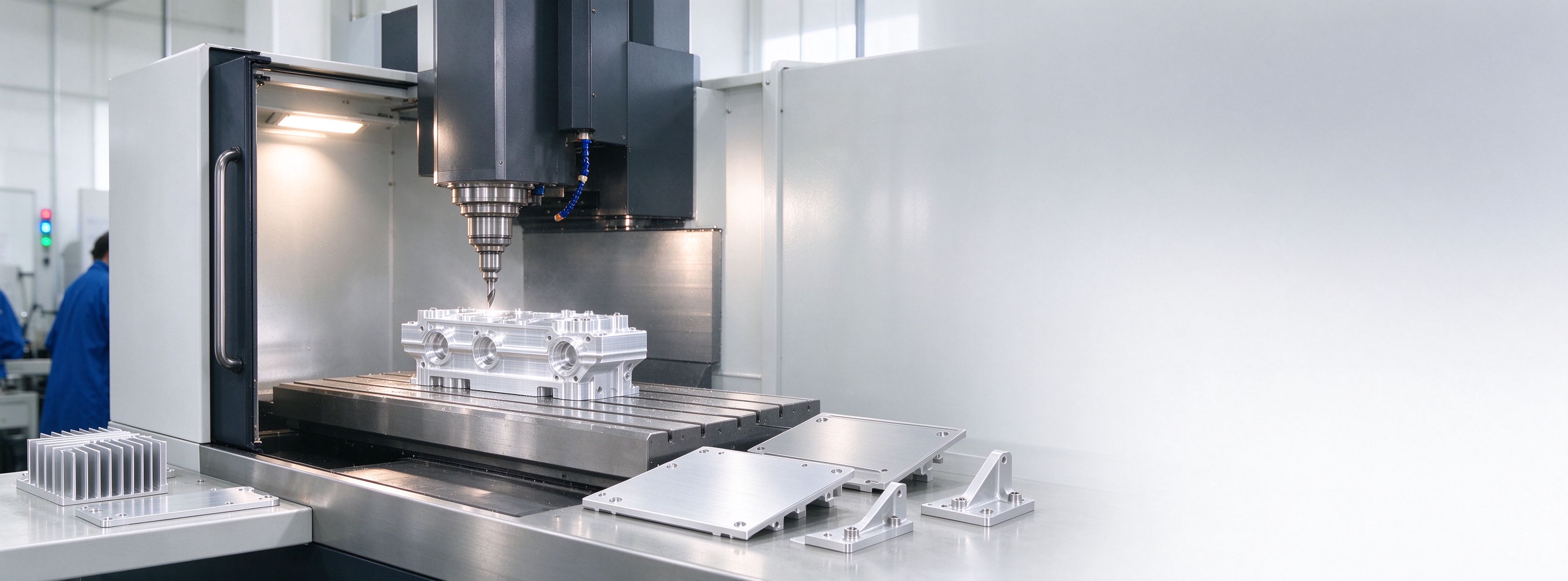
CNC machining centre: vertical machining center cutting an aluminium housing
Insight
Technical Blog & Industry Insights

Machining know-how, process notes and industry updates from our CNC production floor.

CNC Turning Component Supplier Checklist for High-Volume Orders

  • CNC Turning Component Supplier Checklist for High-Volume Orders Eren
  • 24th September 2026

CNC Turning Component Supplier Checklist for High-Volume Orders

Setting the Benchmark for High-Volume CNC Turning Sourcing

Moving custom rotational parts from early prototypes into steady production often brings risks that typical machine shops find difficult to control. When ordering large numbers of precision CNC-turned parts each month, teams should check more than just hourly rates from a precision CNC turning supplier. This step helps avoid downtime on assembly lines and expensive rejected batches.

  • Batch-to-Batch Dimensional Stability: High-volume CNC turning needs careful temperature control and regular tool-wear checks. This keeps the 100,000th unit within microns of the first and supports steady batch-to-batch consistency.
  • Integrated Process Capabilities: Good output comes from multi-axis turning lathes with live tooling. These machines combine CNC milling and CNC turning for cross-milling, tapping, and side-drilling in one setup.
  • Quality Documentation Traceability: A reliable CNC turned parts manufacturer supplies full records. These include material certifications, first inspection notes, First Article Inspection (FAI) reports, and ongoing statistical data.
  • OEM Partner Selection: Specialized manufacturers like Rejin CNCoffer the needed CNC machining production capacity and engineering help for stable CNC turning mass production and long-term high-volume supply.

Technical Capability & Machine Fleet: Evaluating Production Capacity

Shop equipment from a supplier sets how well they can hit delivery dates while maintaining part accuracy. Checking CNC machining production capacity means looking at spindle types, automation levels, total machine count, and how secondary steps fit together.


Multi-Axis Turning Capability and Fleet Scale

A review of the equipment shows whether the precision CNC turning supplier can handle sudden order increases and still keep tight tolerances with steady results.

  • Machining Fleet Capacity & Automation: Shops with over 200 CNC machines run steady output for high-volume CNC machining and large orders. The fleet includes multi-axis Japanese turning centers such as Star and Citizen Swiss-type lathes along with Amada milling units.
  • Process Integration via CNC Milling and CNC Turning: Lathes fitted with live tooling combine CNC milling and CNC turning in one setup. This removes extra handling steps and shortens cycle times on complex shafts and precision CNC-turned parts.
  • Material Versatility and Tooling Rigidity: Modern precision CNC turning setups handle 6063-T5 aluminum, 304/316 stainless steel, brass, and alloy steels without much tool deflection during rough cuts.

Stamping vs. Precision CNC Turning Decision Thresholds

The choice between subtractive work and sheet metal stamping depends on part shape, wall thickness, tolerance needs, and tooling cost.

  • Production Volume Cut-Offs: Simple cylindrical shells under 1.5 mm wall thickness suit progressive die stamping once volume passes 50,000 units. High-volume CNC turning is better for thick-walled, threaded, or multi-stepped shafts no matter the batch size.
  • Tolerance Limits and Feature Complexity: Metal stamping has trouble holding tolerances tighter than ±0.05 mm. Tight-tolerance CNC turning holds ±0.01 mm concentricity and fine surface finishes on a regular basis.
  • Tooling Amortization and Lead Time Flexibility: Stamping needs $15,000–$50,000 in hard tooling with long lead times. CNC turning for mass production uses modular carbide tooling that allows quick drawing changes without losing costly dies.

Quality Assurance & Process Controls for Mass Production

High-volume CNC machining demands strict process controls to prevent systemic defects. A qualified CNC turned parts manufacturer should combine preventative engineering reviews, controlled machining parameters, and multi-stage metrology throughout production.
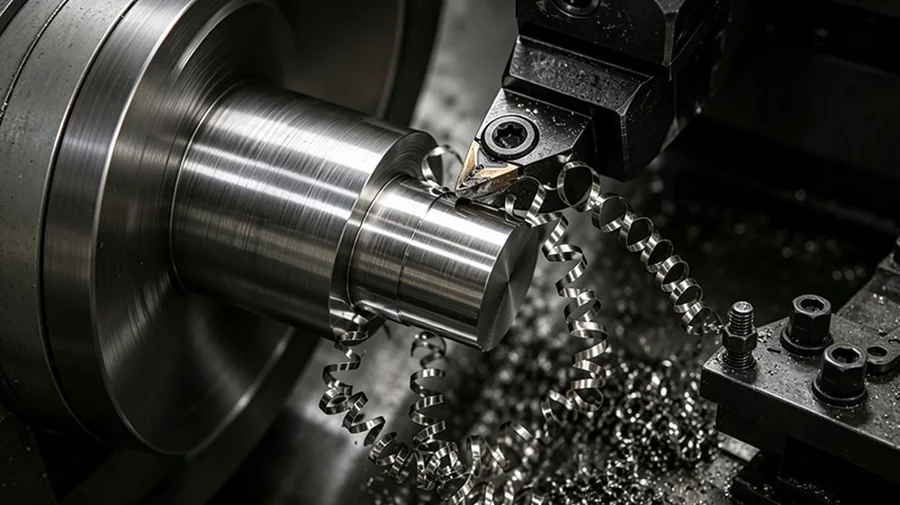
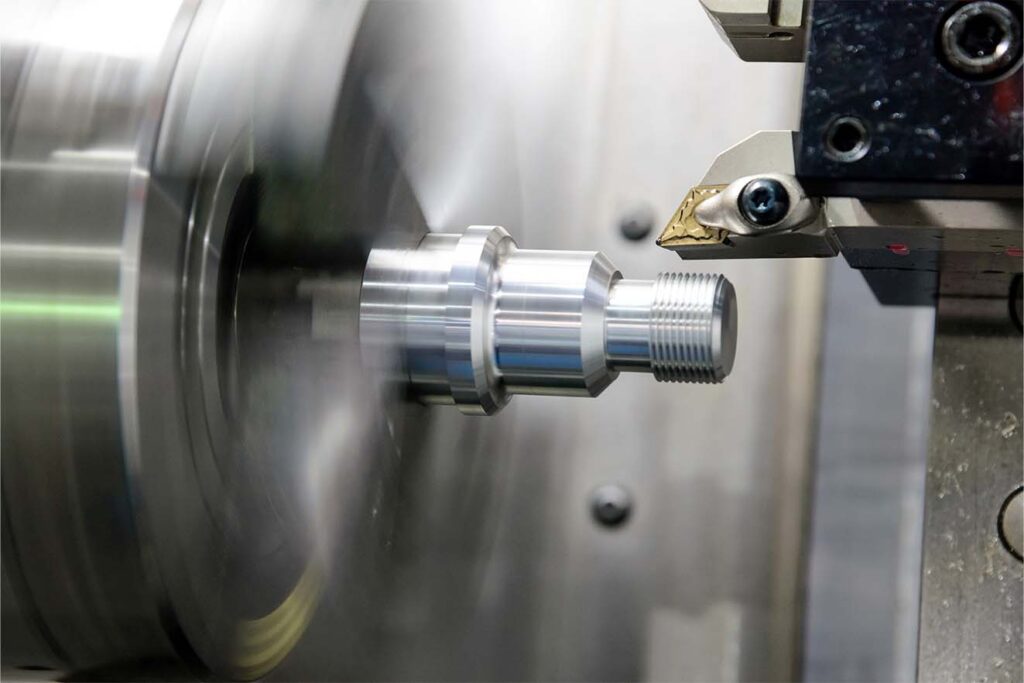
CNC turning capacity supports high-volume precision production

Engineering Risk Mitigation via Early CNC DFM Review

Resolving manufacturability issues on paper prevents tool breakage, chatter marks, dimensional instability, and unnecessary production delays.

  • Pre-Production Geometry Optimization: A thorough CNC DFM review identifies deep internal grooves, sharp internal radii, and ultra-thin walls that can cause chatter, allowing geometry to be optimized before precision CNC turning toolpaths are generated.
  • Thermal Drift Management: Machine thermal expansion during 24-hour continuous machining must be counteracted by temperature-controlled coolant systems and periodic machine offset adjustments to maintain CNC turning repeatability.
  • Raw Material Verification: Validating raw bar stock through Material Test Reports (MTR) ensures consistent hardness and helps prevent thread pitch or dimensional variation during high-volume CNC machining runs.

An effective CNC DFM review is particularly valuable before CNC turning mass production, because small manufacturability issues can become costly when repeated across tens of thousands of parts.

Rigorous Inspection Framework from FAI to Volume Output

Quality systems need to pick up on dimensional drift before nonconforming parts end up in the customer’s assembly line.

  • First Article Inspection (FAI) Procedures: Rigorous First Article Inspection (FAI) measures tooling shape, spindle alignment, machine offsets, and dimensions before putting a machine in production mode for CNC turning.
  • In-line CMM Inspection Systems: Coordinate Measuring Machines (CMMs) check internal diameters, thread size and angle, tapers, and other dimensions per CAD drawings.
  • Statistical Process Control (SPC): Monitoring the Cpk values (>1.33) of batches ensures consistency between batches, which gives customers assurance that their parts are uniform from one shipment to another each month.

All these quality tools and systems are important for keeping CNC turning repeatability in place throughout the manufacturing run.

Practical Case Studies and Operational Proof

Verifiable production statistics demonstrate whether a precision CNC turning supplier has the actual CNC machining production capacity to manage technical challenges, volume ramps, and tight quality requirements.
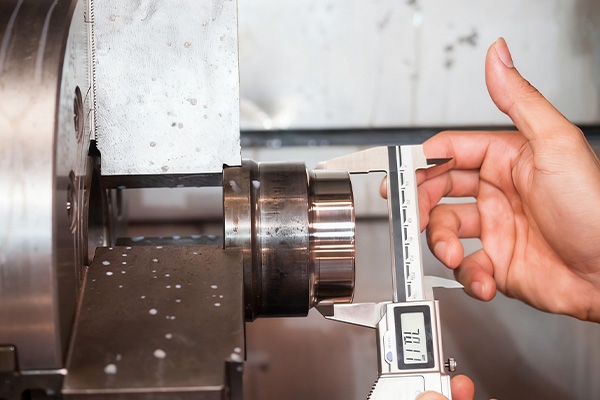
CNC quality controls ensure repeatability in mass production

Case Study: High-Volume Precision Turned Fasteners for Automotive Hardware

Automotive hardware assemblies demand tight tolerances, stable CNC turning repeatability, and dependable monthly deliveries.

  • Project Scope and Scale: Contracted by a Tier-1 automotive hardware supplier to manufacture 150,000 custom stainless steel turned studs and knurled fasteners per month.
  • Engineering Challenge and Solution: Machining precise M4 micro-threads while maintaining concentricity within ±0.008 mm was achieved by utilizing Swiss-type multi-axis precision CNC turning centers with automatic bar feeders.
  • Quantified Outcome: Maintained a 99.85% first-pass yield across 18 consecutive months of mass production, helping the buyer reduce assembly line stoppage risks while maintaining batch-to-batch consistency.

Case Study: Electroacoustic Metal Components for a European Audio Brand

High-end consumer audio equipment requires both precise mechanical fit and consistent aesthetic surface finishes.

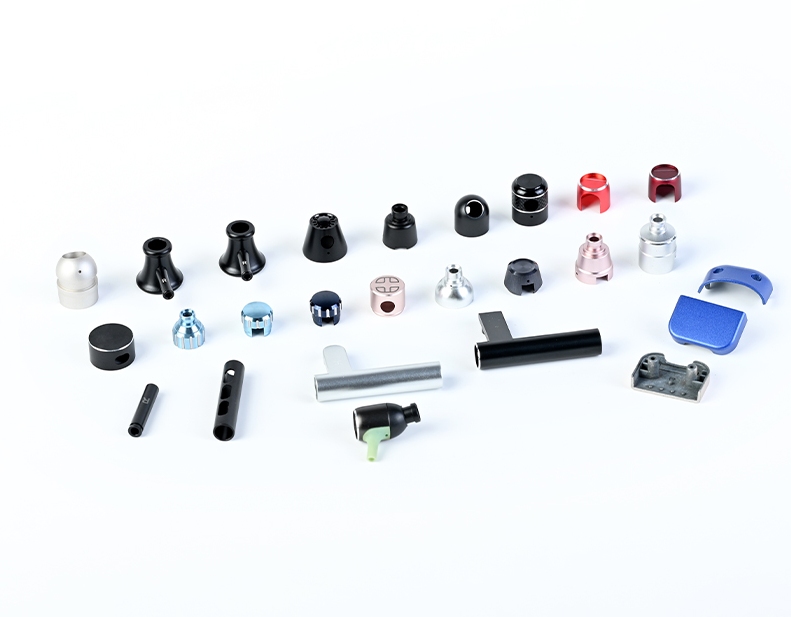
  • Volume Scale and Application: Supplied 30,000 sets per month of custom-turned aluminum audio control knobs and electroacoustic enclosures for a premium European audio brand.
  • Surface and Tolerance Integration: Rejin CNC combined precision CNC-turned parts production with in-house sandblasting and anodizing, holding dimensional tolerances to ±0.01 mm and anodizing color variance within ΔE < 1.0 across batches.
  • Process Innovation: Replaced traditional riveted assemblies with a self-developed embedded seamless riveting process, eliminating visible backplate rivet marks while preserving joint strength.
Project Metric / Evaluation Parameter Tier-1 Automotive Hardware Fasteners European Audio Equipment Housings
Material Specification SUS304 Stainless Steel 6063-T5 Extruded Aluminum
Monthly Production Volume 150,000 pieces / month 30,000 sets / month
Critical Machining Tolerance ±0.008 mm (Thread Concentricity) ±0.01 mm (Dimensional Fit)
Primary Machining Technology Swiss CNC Turning with Live Tooling 5-Axis Turning-Milling & Anodizing
Inspection & Quality Standard 100% Optical & CMM Sampling CMM Verification & ΔE < 1.0 Color

Partnering with Rejin CNC for High-Volume Supply Chains

Working with a precision CNC turning supplier that handles every stage removes the need to coordinate separate machining shops, surface-treatment facilities, and inspection providers.
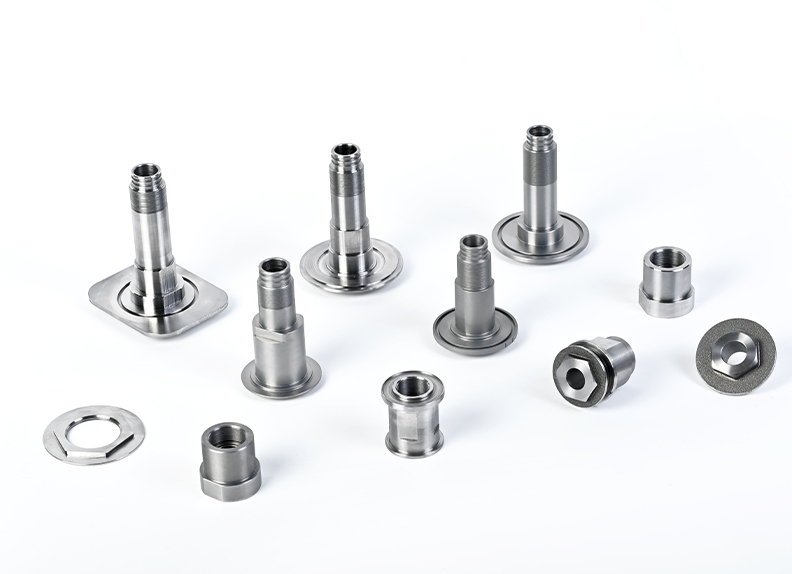
Precision CNC turning case studies demonstrate scalable manufacturing performance

Integrated OEM Manufacturing and Global Delivery

Rejin CNC runs its own production workshops in Dongguan, China. The company delivers full contract manufacturing services to OEM buyers around the world.

  • One-Stop In-House Workflow: From the initial CNC DFM review through CNC milling and CNC turning, plus surface finishing such as anodizing and passivation, all the way to final assembly, every step stays under one quality system.
  • Flexible Order Ramping: Rejin CNC supports project needs from quick 500-piece trial runs up to steady monthly volumes above 200,000 precision CNC-turned parts, showing strong CNC machining production capacity.
  • Engineering-Driven Customer Support: Machining engineers answer technical questions directly, backed by 24-hour quotes and full DFM feedback.

This integrated setup helps B2B buyers keep batch-to-batch consistency when moving from small trials into CNC turning mass production.

Ready to Scale Your High-Volume Turned Component Orders?

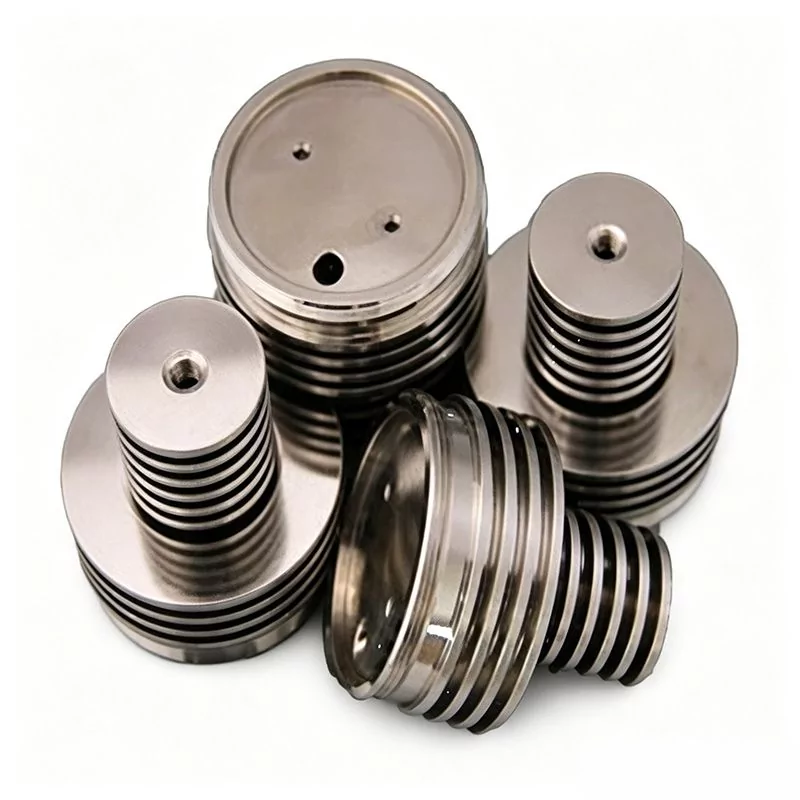
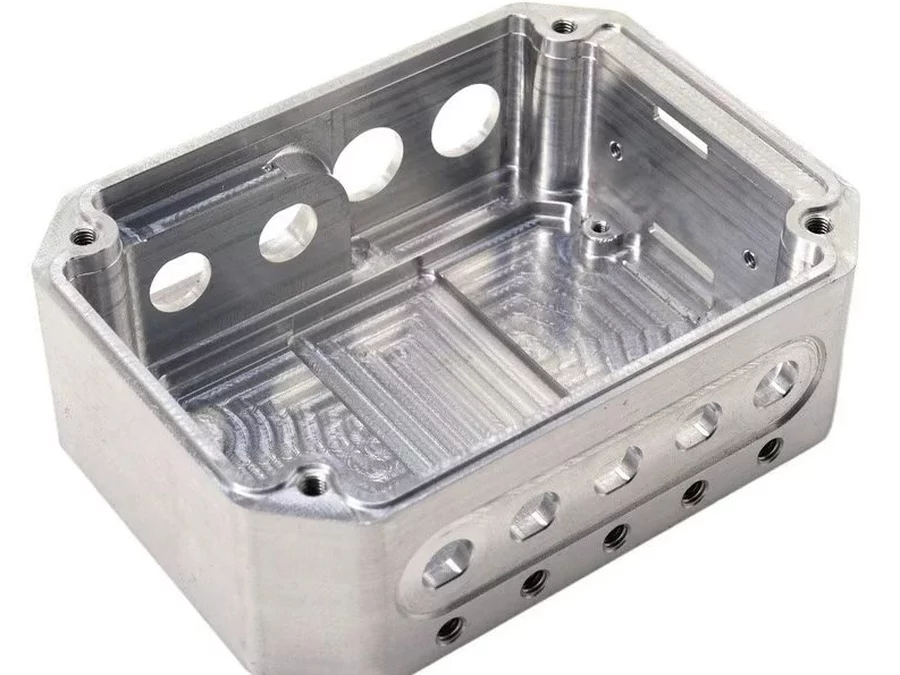
Whether you need high-volume turned studs for automotive assemblies, lightweight drone structural connectors, or heat-dissipation housings for AI liquid cooling systems, Rejin CNC provides precision CNC turning, scalable manufacturing, quality inspection, and integrated finishing for global OEM programs.

Contact Rejin CNC Today for a Free DFM Review & Instant Quote

Email your 3D CAD drawings (STEP/IGES) to info@rejincnc.com to receive engineering feedback and production pricing within 24 hours.

FAQ

Q: How do engineers determine whether a rotational part is better suited for CNC turning or multi-axis CNC milling?

A: Rotational symmetry often decides the best process. Parts with mostly outer diameters, stepped shafts, threads, or concentric bores fit well with precision CNC turning. Complex shapes without symmetry might need multi-axis milling instead. CNC milling and CNC turning together work well if a single part has both kinds of features.

Q: What are the primary drivers of dimensional drift during high-volume CNC turning production runs?

A: Dimensional drift often starts with spindle heat, tool wear, and changes in material hardness. During high-volume CNC turning, a qualified precision CNC turning supplier manages these issues with steady coolant, tool wear checks, small offset fixes, and regular CMM inspection. This keeps CNC turning repeatability steady across long runs.

Q: Why is First Article Inspection (FAI) critical before scaling up to mass turned component production?

A: First Article Inspection (FAI) checks machine offsets, tool paths, fixture hold, and material match, along with final sizes, before CNC turning mass production starts. This step catches setup mistakes early so large batches do not waste material.

Q: What key statistical metrics should B2B buyers request to verify batch-to-batch consistency from a CNC turned parts manufacturer?

A: Buyers need to ask for Cpk numbers on key sizes, with targets at 1.33 or more. They should also get full CMM inspection reports, Material Test Reports, and Certificates of Conformance. These papers confirm batch-to-batch consistency from a CNC-turned parts manufacturer.
 

Tags:

Table of Contents

Frequently Asked Questions

The ordering process is simple: 1.Submit your design files 2.Select materials and manufacturing processes 3.Receive quotation 4.Confirm the order 5.Production and delivery
We provide a wide range of services, including CNC Machining Services, Sheet Metal Fabrication, Surface Finishing Solutions, and DFM Analysis Support.
We offer multiple CNC machining materials, such as Copper (Cu), Iron (Fe), Aluminum (Al), Stainless Steel, and Engineering Plastics.
We accept credit card, PayPal, and T/T Bank Transfer.
Yes. You can track your order via our online tracking system or contact our support team through Customer Support Team.
Our CNC machining delivers high precision, typically with a tolerance up to ±0.005mm, depending on the material and complexity of the part.
Yes. We offer design and engineering assistance to bring your ideas to life. Our team can help with product design, prototyping, and optimization.
RELATED PRODUCTS

Parts We Machine Every Day

View More
SIMPLE PROCESS

What Happens After You Click Send?

1
Inquiry Received

Your message lands directly with our senior engineers — instantly acknowledged.

2
Engineer Review

We study your requirements and propose a workable solution with material & process options.

3
Quote Within 24h

Detailed quotation with specs, options and lead time — no hidden fees.

4
Sample & Production

Approve the sample, then we mass-produce with full QC and on-time shipping.

WhatsApp: +86 13790500374

Email: info@rejincnc.com

Request a Quote

Custom Quote Within 24 Hours

    Full Name *

    Business Email *

    Phone / WhatsApp *

    Company Name

    Upload Drawing / Sketch (Optional)

    No file selected

    Project Details

    Your CAD files are kept strictly confidential. Quotation within 24 hours.