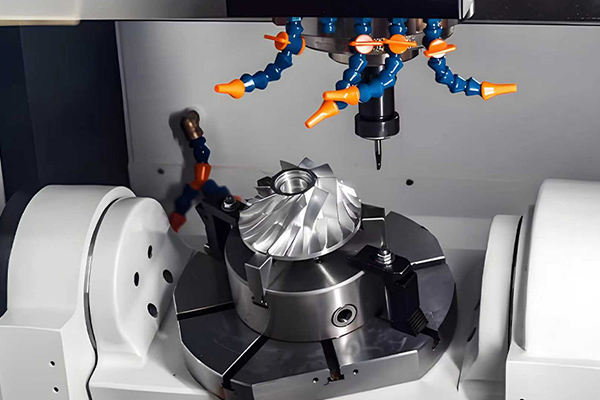
5-Axis CNC Machining
5-axis CNC machining is an advanced form of milling that represents the highest level of precision and complexity. As the name suggests, it adds two rotational axes (typically A and C) to the standard three linear axes (X, Y, Z). Ideal for machining parts with complex geometries.
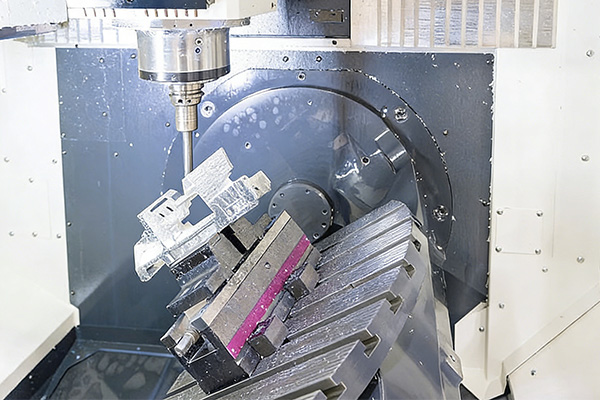
With its unique technical advantages, 5-axis CNC machining is widely used in core high-end manufacturing fields such as aerospace, medical equipment, automotive manufacturing, and high-end molds: In the aerospace field, it is used to process complex curved surface parts such as aircraft engine blades and spacecraft structural parts, meeting the high-precision processing needs of difficult-to-process materials such as titanium alloy; In the medical equipment field, it produces implants such as artificial joints and dental implants, ensuring biocompatibility and use safety with micron-level precision, complying with the ISO 13485 medical industry certification standard; In the automotive manufacturing field, it adapts to the mass production of new energy vehicle motor housings and transmission special-shaped components, improving product performance and production efficiency; In the high-end mold field, it processes complex cavities and cores of injection molds and die-casting molds, ensuring mold precision and improving the qualified rate of finished products. In addition, it also plays a key role in the processing of turbine components in fields such as wind power and energy equipment.
5-axis CNC machining has become a core supporting technology for high-end manufacturing with four core advantages: First, integrated full-process processing. One-time clamping can complete the processing of multi-faceted and complex structures, which can reduce the number of clamping times by more than 80% compared with traditional 3-axis machining, greatly reducing positioning errors; Second, ultra-high precision and stability. Through real-time optimization of tool posture and multi-axis linkage compensation, micron-level machining accuracy can be achieved, while ensuring the consistency of batch parts and improving the surface finish to below Ra0.8μm; Third, extremely strong processing flexibility. It can accurately process complex components such as impellers, mold cavities, and medical implants that cannot be completed by 3-axis/4-axis machines, adapting to the high-value-added production needs of multi-variety and small-batch; Fourth, significantly improving production efficiency. The processing cycle is shortened by optimizing the cutting path. For example, the processing cycle of new energy vehicle motor housings can be reduced from 120 minutes to 45 minutes, while reducing tool wear and lowering comprehensive production costs.